| State | Rank | Most corrupt services[9] |
|---|---|---|
| Kerala | 1 | Less corrupt |
| Himachal Pradesh | 2 | Less corrupt |
| Gujarat | 3 | Education, Land Administration and Judiciary |
| Andhra Pradesh | 4 | Hospital and Water Supply |
| Maharastra | 5 | Municipal services |
| Chattisgarh | 6 | -- |
| Punjab | 7 | PDS, Police, Judiciary and Municipal services |
| West Bengal | 8 | Water Supply |
| Orissa | 9 | Judiciary |
| Uttar Pradesh | 10 | Electricity, Schools and Income Tax |
| Delhi | 11 | PDS |
| Tamil Nadu | 12 | Schools, Hospital, Income Tax and Municipalities |
| Harayana | 13 | Schools, Land Administration and Police |
| Jharkhand | 14 | -- |
| Assam | 14 | Police, Electricity |
| Rajasthan | 15 | -- |
| Karanataka | 16 | Income Tax, Judiciary, Municipalities and Rural & Farming infrastructure |
| Madhya Pradesh | 18 | -- |
| Jammu and Kashmir | 19 | Most services except Hospitals and Rural & Farming infrastructure |
| Bihar | 19 | All services |
Tuesday, December 1, 2009
Corruption across various States of India
India Corruption & Bribery Report
What is the amount of bribes requested by people in India?
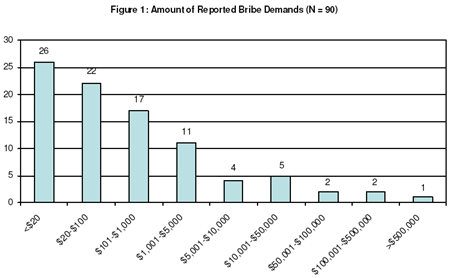
The above numbers clearly suggest that Bribery in India is at a grass root level with close 86% demands were done for $5000 or less (2,50,000 rupees or less, out which more than half were for $26 (Rs. 1300) or less.
Because, corruption takes place at such a grass root level, it is extremely difficult to contain it.
Having said that, 14 people out of 100 taking bribes are for amount more than $5000 (Rs. 2,50,000). Actually, if you look at the top officials are even more corrupt. I will tell you why I say that –
The number of big bosses is merely 1%-2% of all officials, yet according to the report 14% of bribes are of huge amounts, showing that big bosses are involved even more compared to low level officials who are taking bribes.
On a sidenote, China’s number is much higher with 24% of reported demands were for amounts between $5,001 and $50,000, 6% of reported demands were for amounts between $50,001 and $500,000, and 6% were
for amounts greater than $500,000. interesting…
- What is the nature of Bribe Demands in India?
No guesses here – if you want to get your work done, bribe em’ ! thats what is quite clear and in line with the notion we have.
harm, including securing the timely delivery of a service – which is actually a right of a person (such as clearing customs or having a telephone line installed) and receiving payment for services already rendered
Only 12% of the bribe demands were for gaining a personal or business advantage (including exercising influence with or over another government official, receiving inappropriate favorable treatment or winning new business).
One thing for sure, we are now used to this corrupt system and take it in our stride as part & parcel. We do not want to go extra lengths and take the easy way out. But this easy way out is actually the roots of corruption in India.
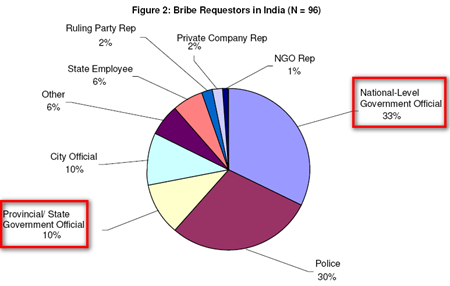
Who demand bribe in India?
No guesses here !
Do you know which of the two Indian ministries ask for bribe more than other? – They are Customs office (13%) and Taxation and Water (9%).
China fares slightly well when it comes to Government officials taking bribe (85%) – Another major difference is that India Police (30%) are far more corrupt than their Chinese counterparts (only 11%).
What is the frequency of Bribe Demands in India?
Nearly 90% indicated being solicited for a bribe between two and 20 times.
Overall 60% people reported bribe demands of 5 times or lower from the same individual. However, 9% asked for bribes more than 100 times.
Compared to China, it differs significantly with 73% people indicating that they had received multiple bribe requests. Almost 20% of those individuals reported receiving more than 100 bribe demands in China.
In what form was the bribe requested?
If in doubt, give cash, as 92% of all bribes are preferred to be “cash or cash equivalent,” The next best thing is a “gift,” (5%) including requests for company products, jewelry and similar items. Less common still, at approx. 1% each, were requests for hospitality or entertainment items; travel for other than business purposes; and other assistance, such as
help with a visa, medical care, or scholarships.
Surprisingly, there were no reports in India of demands for “additional business” or “sexual favors.” In China, those demands accounted for a combined total of 7% of reported bribe solicitations.
So, there you have it – How, what, who and why of Indian Corruption.
[These numbers were gathered from BRIBEline, a project managed by TRACE International Inc., an anonymous online reporting tool that collects data about bribe solicitations made by official, quasi-official and private sector individuals and entities in India ]
Author: Arun Prabhudesai
Thursday, September 10, 2009
Political Corruption
Political corruption is the use of legislated powers by government officials for illegitimate private gain. Misuse of government power for other purposes, such as repression of political opponents and general police brutality, is not considered political corruption. Neither are illegal acts by private persons or corporations not directly involved with the government. An illegal act by an officeholder constitutes political corruption only if the act is directly related to their official duties.
All forms of government are susceptible to political corruption. Forms of corruption vary, but include bribery, extortion, cronyism, nepotism, patronage, graft, and embezzlement. While corruption may facilitate criminal enterprise such as drug trafficking, money laundering, and trafficking, it is not restricted to these organized crime activities. In some nations, corruption is so common that it has gained normative status. The end point of political corruption is a kleptocracy, literally "rule by thieves".
The activities that constitute illegal corruption differ depending on the country or jurisdiction. Certain political funding practices that are legal in one place may be illegal in another. In some countries, government officials have broad or poorly defined powers, and the line between what is legal and illegal can be difficult to draw.
Bribery around the world is estimated at about $1 trillion (£494bn), and the burden of corruption falls disproportionately on the bottom billion people living in extreme poverty.Monday, April 14, 2008
Who can check or remove corruption in India...
CorruptionFreeWorld.com
Corruption plagues this great world of ours, from Africa to America and everywhere in between, varying only in degree (and not in kind) from nation to nation, society to society. Some have argued that corruption is necessary for smooth functioning of societies, others even that it is beneficial to all involved. Fortunately, neither is even remotely true. That corruption harms the victim on whom it is perpetrated needs no elaboration. But that it also surely harms the perpetrator does. Perpetrators often need the collusion of their peers and connivance of their superiors (to whom they owe their power and its attendant benefits). As a result, they are forced to share their spoils with these peers and superiors. Worse, they also live in constant fear, of being betrayed or exposed. This constant fear they live in as well as the easy money they have access to force them to lead sub-optimal lives, inhibiting them from fully using their potential.
It is no secret that corruption plagues the underdeveloped and developing world, but as political and corporate scandals in rich countries remind us time and again, it plagues the developed world as well. Corruption may be widespread and pervasive in poor nations (with almost no one untouched by it), but its scale and intensity by and large are often of much smaller in magnitude than in rich nations (with a few notable exceptions, of course). This, however, by no means makes corruption in poor nations benign or even harmless; for, although small in magnitude, the havoc corruption in poor nations wreaks on victims is perhaps more devastating than it does in rich nations. In rich nations, on the other hand, corruption is not as pervasive, but where it occurs, is severe in scale and intensity.
Corruption’s pernicious claws hurt more than just individuals and families – they hurt economies as well. As the OECD quote above indicates, economists are coming around to the view that, contrary to previously held conventional wisdom, corruption’s impact on economic growth is significant, and that it is no coincidence that the world’s poorest nations also tend to be the most corrupt.
So what does CorruptionFreeWorld.com have to do with all of this? As we all know, corruption’s greatest friends are fear exerted by the perpetrator on the victim and secrecy into which the victim is coerced as a result. By providing a forum where corruption can be reported to the whole wide world anonymously, our hope is the following: a) victims will be encouraged to report abuse without fear or favor b) perpetrators will be deterred from crimes in the future as well as brought to justice for their crimes in the past, and c) finally, well-meaning corruption fighting governments and their law-enforcement bodies can use this forum as a resource to track down perpetrators and crack down on the bane that hurts us all.
Combating corruption
AS A DOCUMENT which enumerates the various socio-economic causes of corruption in India and catalogues the measures needed to arrest it, the Vigilance Commission's just-released Citizens' Guide does not contain many novel or trailblazing ideas. But it does more than a good job of identifying the appalling scale of the problem and the urgent need to tackle it. Much of the subject matter between the two covers of the CVC's guide to fighting corruption has a familiar ring to it. This is not surprising as the publication bears the unmistakable stamp of the Chief Vigilance Commissioner, Mr. N. Vittal, who has used his office to carry out a high-profile campaign aimed, on the one hand, at the modification of the rules and procedures which encourage corruption and, on the other, at sensitising the public about the menace.
Corruption in India has assumed such large proportions and variegated forms that large numbers of the public have come to believe that it is impossible to get rid of this malaise. In such an atmosphere of pervasive cynicism, one of the things that the guide repeatedly emphasises - and quite correctly - is that the scourge can be managed or controlled. Other countries have been notoriously corrupt in the past (for example, Britain in the 18th century) but have succeeded in tackling the problem through a mixture of administrative and electoral reform. The situation in America during the late 19th century vis-a-vis corruption bears a strong causal resemblance to that which exists in India and many other developing countries today. In dispelling the gloomy but widespread notion that corruption in India cannot be curtailed, the Citizens' Guide notes that even Botswana, according to a World Bank report, has improved the probity in its public life.
The Chief Vigilance Commissioner, who evidently perceives his office as a catalyst for organising a war against corruption in India, may be a tad too optimistic if he believes that the guide could become a common basis for citizens or groups of citizens to mobilise themselves in this effort. But in a country which buckles under the gigantic burden of corruption and struggles to find a way to overcome its oppressive weight, any step towards giving the still-nascent anti-corruption movement a fillip deserves to be warmly commended. The guide acknowledges the need for a variety of strategies to fight corruption, ranging from general measures such as the simplification of rules and procedures and the application of information technology to specific steps such as trapping corrupt public servants. While agencies such as the CVC can play a vital role, any comprehensive strategy to combat corruption would have to involve other bodies such as NGOs and the print and electronic media.
Although it may hurt the pride to admit it, India is one of the most corrupt countries on the world map. The latest Corruption Perception Index conducted by Transparency International, a Berlin-based NGO which conducts an annual survey which attempts to aggregate perceptions of corruption within countries, ranks India a lowly 72 out of a list of 91 nations. It is small comfort that nations such as Bangladesh or Uganda rank lower in this list of infamy. As early as 1964, the Santhanam Committee, which was set up to examine the increasing menace of corruption in the administration, observed that the ``tendency to subvert integrity in the public services instead of being isolated... is growing into an organised well-planned racket''. If anything, it has grown much larger and become even better organised since. The war against corruption is formidable and not going to be easy to win, but the CVC or anyone else who fires a few salvos deserves to be cheered for engaging the enemy.
RTI brought marked decline in corruption in India
Right to Information (RTI) Act has served as a powerful weapon in fighting corruption which has shown a marked decline in the country, according to the latest Corruption Perception Index .
Published by the Transparency International, India's corruption index showed a marked decline from 88 to 70th position. The single-most reason for the drop in corruption in government was attributed to the Right to Information Act.
Mr George Cherian of the Centre for Consumer Action, Research & Training (CART) informed this at a semiar on ''One year of RTI in Rajasthan:Problems and possibilities'' here today.
He said out of the 183 countries' corruption indices, India's index declined by 18 points compared to that in 2005 and the major reason attributed to this steep fall is the public scrutiny through Right to Information Act.
Chief Information Commissioner of Rajasthan M D Kaurani, speaking on the occasion, emphasised the need for a separate executive wing and fund for the commission to make the implementation of the law more effective. He said at present the Home department is entrusted with the responsibility of execution and it is one among many responsibilites with the Home department. Besides, there is no separate fund allocated for RTI.
He said the Commission would soon launch a helpline in the state and added that ''though the significance of the law has been acknowledged, there is need to make it more powerful and effective with more fund and staff''.
Mr Venkatesh Nayak of the Commonwealth Human Rights Initiative(CHRI) and Mr Nikil Dey of the Mazdoor Kisan Shakti Sangatan also spoke on the occasion.