What is the amount of bribes requested by people in India?

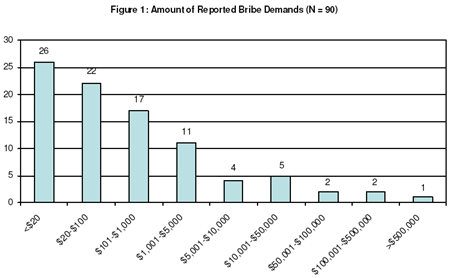
The above numbers clearly suggest that Bribery in India is at a grass root level with close 86% demands were done for $5000 or less (2,50,000 rupees or less, out which more than half were for $26 (Rs. 1300) or less.
Because, corruption takes place at such a grass root level, it is extremely difficult to contain it.
Having said that, 14 people out of 100 taking bribes are for amount more than $5000 (Rs. 2,50,000). Actually, if you look at the top officials are even more corrupt. I will tell you why I say that –
The number of big bosses is merely 1%-2% of all officials, yet according to the report 14% of bribes are of huge amounts, showing that big bosses are involved even more compared to low level officials who are taking bribes.
On a sidenote, China’s number is much higher with 24% of reported demands were for amounts between $5,001 and $50,000, 6% of reported demands were for amounts between $50,001 and $500,000, and 6% were
for amounts greater than $500,000. interesting…
- What is the nature of Bribe Demands in India?

No guesses here – if you want to get your work done, bribe em’ ! thats what is quite clear and in line with the notion we have.
More than half of all the bribes were paid to get the work in time !
77% of all reported bribe demands in India are related to the avoidance of
harm, including securing the timely delivery of a service – which is actually a right of a person (such as clearing customs or having a telephone line installed) and receiving payment for services already rendered
Only 12% of the bribe demands were for gaining a personal or business advantage (including exercising influence with or over another government official, receiving inappropriate favorable treatment or winning new business).
One thing for sure,
we are now used to this corrupt system and take it in our stride as part & parcel. We do not want to go extra lengths and take the easy way out. But this easy way out is actually the roots of corruption in India.
Who demand bribe in India?

No guesses here !
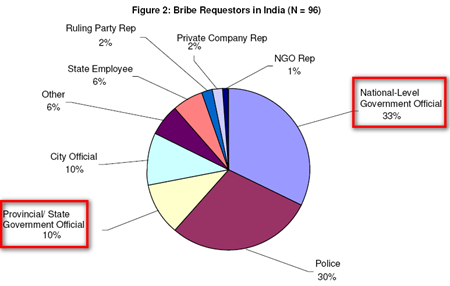
Whooping 91% of reported bribe demands originate from government officials in India.
The greatest sources of bribe demands, were from national level Government officials (33%), the police (30%), state/provincial officials and employees (16%), and city officials (10%) respectively .
Do you know which of the two Indian ministries ask for bribe more than other? – They are Customs office (13%) and Taxation and Water (9%).
China fares slightly well when it comes to Government officials taking bribe (85%) – Another major difference is that India Police (30%) are far more corrupt than their Chinese counterparts (only 11%).
What is the frequency of Bribe Demands in India?

Nearly 90% indicated being solicited for a bribe between two and 20 times.
Overall 60% people reported bribe demands of 5 times or lower from the same individual. However, 9% asked for bribes more than 100 times.
Compared to China, it differs significantly with 73% people indicating that they had received multiple bribe requests.
Almost 20% of those individuals reported receiving more than 100 bribe demands in China.
In what form was the bribe requested?
Do you want any tips on how to give bribes? here is what our corrupt officials prefer..
If in doubt, give cash, as 92% of all bribes are preferred to be “cash or cash equivalent,” The next best thing is a “gift,” (5%) including requests for company products, jewelry and similar items. Less common still, at approx. 1% each, were requests for hospitality or entertainment items; travel for other than business purposes; and other assistance, such as
help with a visa, medical care, or scholarships.
Surprisingly, there were no reports in India of demands for “additional business” or “sexual favors.”
In China, those demands accounted for a combined total of 7% of reported bribe solicitations.
So, there you have it –
How, what, who and why of Indian Corruption.
[These numbers were gathered from BRIBEline, a project managed by TRACE International Inc., an anonymous online reporting tool that collects data about bribe solicitations made by official, quasi-official and private sector individuals and entities in India ]
Author: Arun Prabhudesai